Problem
What can we do to make the digital experience possible in any company with API? A number of things could plague a business’s bad or slow APIs: data mismatch, cross-platform integration issues, scaling issues, poor developer experience, and data security risks. Each can affect a business’s growth and innovation because it can’t integrate apps and data from one platform to the next.
Solution
If an organization wants to deliver great digital experiences in the competitive world, it must take digital transformation seriously. An API-First methodology is important to build new products, rise above the competition, and deliver a seamless customer journey. If you invest in the right API strategy, you can make new products, be mobile, and gain market share.
API strategy directly impacts platform thinking and you should plan a proper API strategy base. An API strategy is simply developing, designing, and deploying Application Programming Interfaces (APIs) to inform an organization’s technical environment. It’s a roadmap for building a single scalable API ecosystem based on business objectives tethered to internal and external applications.
API-First Approach Using API Strategy
API-First thinking puts the architecture and creation of APIs at the heart of every piece of software work. Its benefits include more productivity, collaboration, and agility. It is very important to have values and guidelines in place to implement API-First.
Below are a set of principles that must be followed:
- API Strategy Building Blocks: Align the API-First vision to business and technology with API Strategy blocks.
- Definition and Implementation of API Platform Vision: Maturity of an API. Concept for a Platform API Development and Improvement Plan.
- Following API-First Strategy: Basically, this is the approach to design and build APIs first for any application, rather than building an application and then developing some way to expose its functions.
In API-First, we have an explicit API contract—the code to work on both the back- and front-ends, which keeps things consistent and saves on costly reworks later.
API Strategy Components
Here are important components for API Strategy:
- API Charter – A fundamental framework that underpins everything that is done via API in an organization. Consider it the blueprint for your API app.
- API for Business – Make sure that API strategy reflects your business goals and priorities.
- API Design – Properly designed APIs are not only easy to use and integrate, but also easier to keep up, scale, and secure.
- API Governance – Policies and practices used to manage and consume APIs. It is security, versioning, etc.
- API Management – Set of practices, tools, and services to create, publish, secure, manage, and report APIs at every stage of the API lifecycle.
- API Security – Protects private data, maintains service, and preserves your reputation.
- Developer Experience – Provides developers (API users) with a positive, smooth experience. It’s to make API users discover, understand, embed, and use APIs quickly.

API Platform Vision and API Maturity
Several factors play a role when assessing the maturity of an API platform. Here are some common targets to aim for:
| Design APIs | Secure APIs | Publish APIs | API Distribution |
|---|---|---|---|
| Easily, create consistent APIs to digitize products on distribution channel. | Easy and consistent API security implementation with best practices, Encryption, OWASP, threats OAuth 2.0, and TLS. | Self-service, fully automated API implementation publisher site. With tools for easy, secure, and fast API publishing for enterprise teams. | Self-service, single place to register and consume published digitized products and services. Easy implementation experience for partners. |
| Monitor APIs | Analyze APIs | Govern APIs | Support APIs |
| Ensure API availability for seamless experience for application, developer, and customer. | Drill down and investigate API traffic, spikes, and trace live API calls with real-time insights from API Traffic. | To excel in API design and product digitization guardrails to maximize partner integration experience. With cost-efficient, reusable business domain capabilities. | Modern IT service management for cloud applications that add customer value are design-led, preventing service disruptions with zero-touch capabilities and eliminating manual activities. |
API maturity can deliver significant benefits to businesses in the areas of developer experience, business value, efficiency, competitive advantage, and governance. It is never far off and, thus, everyone wins.
API Growth Potential
- API as a Product Strategy – In this approach, API is treated as products meant for a particular target business audience and expected to have measurable outcomes. Below are two main components:
- Domain-Driven API Strategy and Partner with Business – Aim to create APIs that align with business domain requirements. This can be possible through partnerships with businesses.
- API-First Approach – Focus to work on designing API architecture first, then go for implementation.
- API Operating and Governance Model – It helps and tracks efficient development of APIs from design to development to deployment. It has unique stages below:
- Identification – Defines scope and usage of APIs.
- Development – More design and implementation of APIs.
- Deployment – Makes sure there is smooth release of APIs.
- Tracking – Monitors API from usage, efficiency, and performance perspectives.
- Enhance External and Internal Consumer Experience – All organizations require consistent and reliable data access, which provides consumer experience both externally and internally. For that it should have:
- Well-curated External APIs – Provides external partners with the view and use of the APIs as good as the user experience
- Continuous Operational Model/Change Management – Covers the type of change management where there are supports of updates and continuous improvements of APIs.
- Monetization – This feature is about generating money from APIs.
- API Marketplace – A platform where users can discover and purchase APIs and track their consumption.
- Subscription/Chargeback Models – Different types of models are available like a subscription model, usage-based fees, and more complex type models like Chargebacks.
Stakeholders Benefits
Consumers or Partners. Consumers and partners can benefit from API platform through the following capabilities:
- Self-service developer portal for consumer(s) to get onboarded. This portal provides stepwise enrollment of users without help. Here users can generate user details including a token.
- Discover APIs that the organization has to offer. A portal provides access to all APIs and related documentation.
- Test system against organization Sandbox environment. Users will get access to ready sandbox environments where they can test and verify APIs. This will ensure APIs are meeting their requirements.
Developers. An API Platform allows developers to publish and manage their APIs. It helps with improved re-usability. Below are benefits that developer can get:
- Self-publish and self-governed API repository.
- Monitor the dashboard to show SLA.
- Compliance-to-Architecture best practices.
- Support different architectural patterns like REST or GraphQL.
Architects. Architects can use API platforms to make mandatory enforcement of pattern and principal. It gives a way to review and generate non-compliance reports.
Operations. API Platforms help Operations teams through simplified troubleshooting procedures, improved issue discoverability, performance and stability metrics, and a robust security dashboard, that together boost API reliability and operational performance.
API Design Maturity
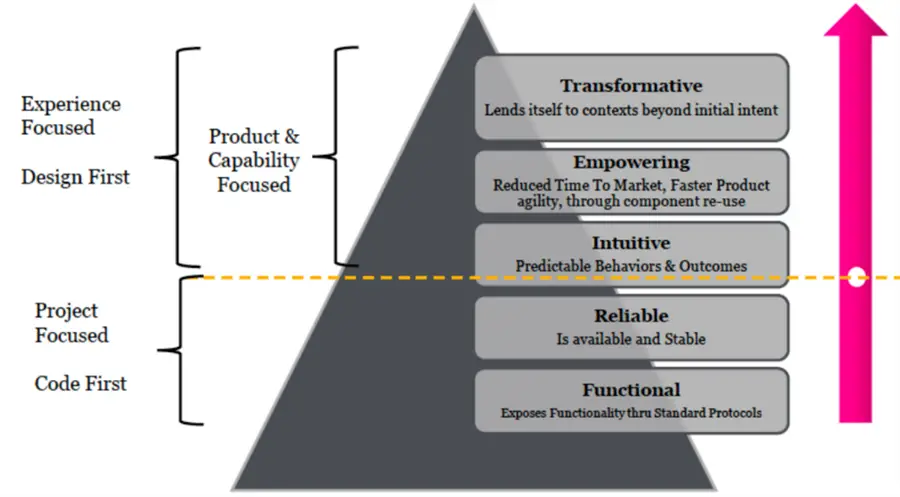
API Design Maturity measures how organizations implement APIs to achieve business objectives from a design perspective. To achieve API Design Maturity, users must target ideal principles while actively avoiding those that hinder maturity progress. Below is a break of such principles.
Avoid these Principles:
- Project Focused – Can lead to siloed API development with different designs across projects. There will be no reusing of APIs and it will result in redundancy.
- Code First – Can lead to poor APIs design and can be difficult to integrate and maintain. It will also lead to lots of technical debt and impact any future developments.
Follow these Principles:
- Experience Focused – Shifting from technology-focused to user-focused. Here we need to understand the needs and expectations of API consumers. Gather iterative feedback which can be implemented in API.
- Design First – The importance of API design is before development. It means the user/architect considers all design scenarios at the start which helps in the reduction of technical debts. It helps improve consistency.
- Product & Capability Focused – Ensuring API meets business goals and delivers value. APIs should also support reusability and composability features through small reusable and independent blocks. Here, the idea is to focus on a strategic roadmap.
Path to API Maturity
This is a plan that describes how a Platform API should be developed and improved. It helps companies understand where they are as well as where they could improve. Here is a diagram of API maturity principles. Eight important API maturity principles are listed and advantages of using those principles.

Embracing the API First Strategy
Create templates for API Platform Team to design, develop, and host an organization’s APIs.
- Setup an API Center of Enablement (API Platform Team)
- Set up Center of Enablement Operating Model
- API Management Platform
- Pilot Implementation

Building Center of Enablement (API Platform Team)
The Center of Enablement (CoE) typically operates as a central hub. It gives guidelines to multiple teams or units within an organization. In API Strategy terms, the CoE does the following:
- Enterprise Vision and Collaboration – Brings together the Business and Technical teams to implement the API Strategy.
- Accountability. Develops clear team structures such as roles and responsibilities.
- Guidelines. Provides concise and practical platform adoption guidelines to enable API adoption.
- Phase-wise Enterprise-wide Mandate. Practitioners driving adoption through training. Coaching. Automation to simplify and accelerate adoption.
- Goal Generation and Adherence. Set success goals with phase-based API maturity-level scaling. Also establish track and monitor metrics.

API Operating Model – Six Essential Model Elements
An API operating model is a holistic framework governing the policy, procedures, and regulations surrounding API development, service provisioning, and use in an organization. It ensures that APIs are planned, developed, and maintained in a consistent, effective, and scalable manner. Below are six of its most important elements:
- Technical Governance – API security and standardization framework. Give the CoE a foothold to standardize and protect API work products. Sets rules and policies for API use and access. It accelerates API development and encourages optimization and reuse of API artifacts.
- Planning and Prioritization – Describes the organization’s intentions and objectives around API creation and usage.
- Standards – Specifies API design guidelines, naming standards, data formats, and security requirements. These consist of Architecture Guides, Design Guidelines, and Security Guides.
- Monetize – Define ways to charge for APIs, if any. Demonstrates cost savings.
- Monitoring & Metrics – Gives insights about API performance, usage, and health, allowing companies to make data-driven decisions and optimize their APIs. It’s more about keeping track of the CoE’s performance.
- Organization Change Management – An easy-to-use methodology that makes little business difference. Documented process for API, process, or governance policy changes.

API Management Platform
An API management system simplifies and centralizes API work. It delivers all the tools and services needed to build, design, create, maintain, and secure APIs. It is, in short, a software platform that supports API lifecycle management (from API development to retirement throughout its lifecycle). It makes code and APIs easier and offers greater business value).
It’s a kind of cross-border digital backend, for partners, developers, and enterprise teams that allows them to develop new things more quickly and effectively and with the same managed catalog of services.
API Management Architecture

Key Components of API Management.
- API Design: Creates, publishes, and deploys APIs and proxy.
- API Gateway: Provides self-service catalog of APIs. Manages the routing and data transformation of messages for the consumers and handles all security, analytics, and performance optimization for all APIs. It offers centralized access control, usage monitoring, and efficiency by decoupling common tasks from the services.
- API Portal: Provides a standard portal where customers register and gain access to a library of APIs. It contains all functionality for API producers and consumers (design, develop, publish, subscribe, consume, govern, and operate).
- Publisher Portal: Designs, develops, and publishes APIs.
- Developer Portal: Subscribes and consumes APIs.
- Governance Portal: Governs APIs.
- Operations Portal: Operates through onboarding, support, and reports.
- API Dashboard/Analytics: Shows API usage and load across locations and provides real-time monitoring and metrics to get insight into API usage and uptime.
- API Lifecycle Manager: Covers the lifecycle of API from creation, securing, publishing, versioning, and monetizing to retirement.
Features of API Management Platform.
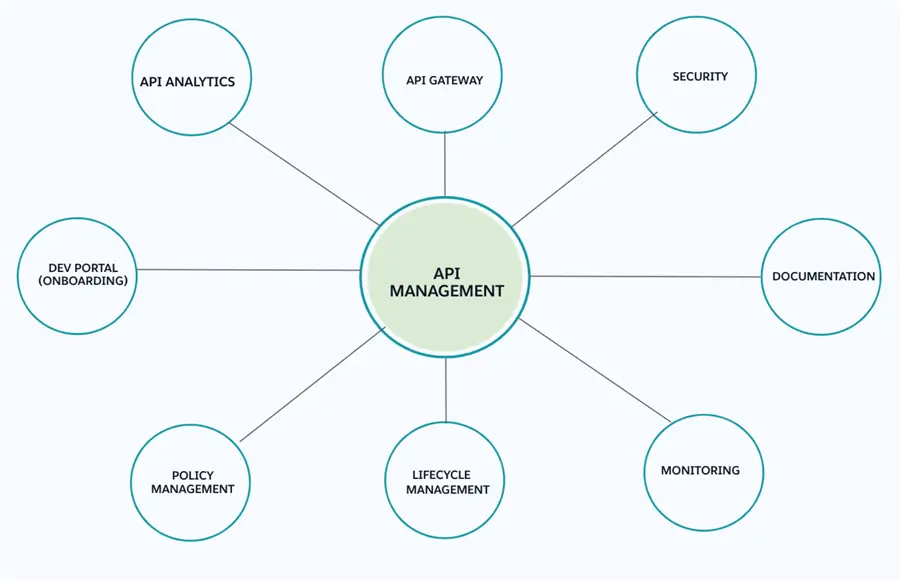
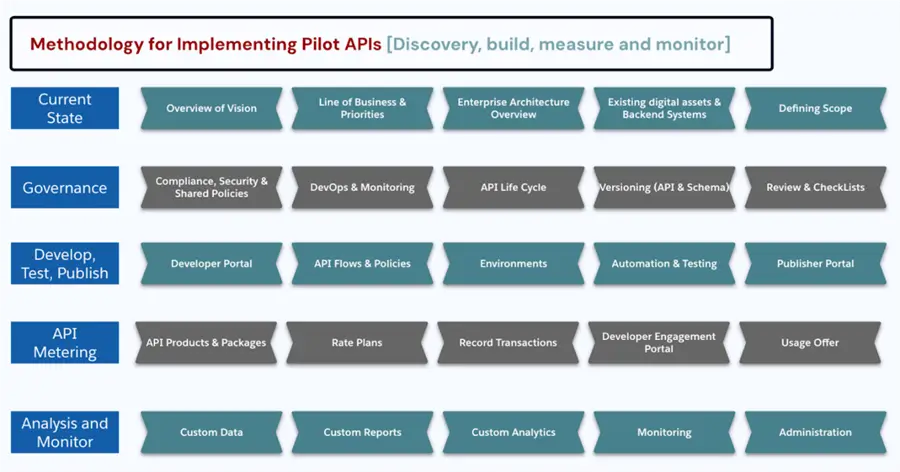
Implementing Pilot Implementation/Industrialize
Defining, prioritizing, building, and deploying different kinds (Process, Domain, System) of APIs as a baseline implementation for citizen developers.
By definition, API Pilot Implementation is the initial step to push an API into a production environment for testing and evaluation. It is an automated test of the API’s capabilities, performance, and readiness for public use. API Industrialization is a journey that moves an API from a pilot to production. It ensures the API can handle increased load and usage in preparation for mass use.
API Implementations Workflow
The workflow intent is to present a standardized process for the execution of an API implementation engagement in the CoE:
- Business Need: API business goals need to be communicated to business teams.
- Technical Requirement: Business needs will drive technical requirements.
- API Build: After finalizing technical requirements, the API is designed, built, tested, and deployed in sprints.
- Policy and Publish: The security policies determined during the design phase will be applied and the API will be published to appropriate end users.
- Evaluation: End-consumer feedback is tracked and processed to iteratively improve and update to a new version as needed.
Summary and Conclusion
Overall, an API strategy is crucial for any organization that wants to make use of APIs. The point is to have best practices for API Strategy, such as form API platform team, enable the operating model, use API management platform, and perform pilot implementation. With a combination of business objectives, user experience, and governance, businesses can build APIs that deliver value, improve customer experiences, and bring in new revenue.
Next Steps
More details related to API Strategy and effective micro-service architecture can be found in the following articles:
- What is an API strategy?
- Monolithic vs Microservices Architecture
- Implement Microservices with Ocelot API-Gateway in .NET
- What is an API Strategy?
- API Primer: Core Concepts in API Strategy and Architecture
- How to Implement an API Strategy in 2024

Shekhar Jha has 23+ years IT leader in integration, data, & cloud architecture. Expertise: enterprise integration, cloud applications, middleware, event systems, databases, Java. Proven ability to develop IT standards, manage teams, mentor architects, lead POCs. Executed multi-country programs (banking, finance, market research), specializing in migrations. Adept in pre/post-sales, integrating banking services. Holds AWS, Azure, PMP, ITIL certifications.