Problem
There are numerous applications to obtain a Matrix inverse for a given Matrix. Is it possible to do it using only SQL Server? Read on to learn how to build a matrix inverse calculator using a set of SQL Server custom functions.
Solution
Matrix operations are not typically performed directly in SQL Server. It is more for relational data, but there are methods available that make it possible. I chose the LU decomposition method.
Terms and Definitions
Matrix Inverse
The inverse of a squared matrix is a matrix that, when multiplied by its original one, results in its Identity matrix. Some applications of Matrix inverse are linear system of equations, computer graphics, cryptography, machine learning, control systems, economics, and others.
Identity Matrix
A matrix is called identity when it has the same number of rows (i) and columns (j), also called squared matrix, with ones in the main diagonal where i = j and zero elsewhere.
The LU Decomposition Method
The first step is to create a User-defined-table to hold the values and its row (i) and column (j):
CREATE TYPE [dbo].[uttMtxIndexed] AS TABLE(
   [lin] [smallint] NULL,
   [col] [smallint] NULL,
   [val] [float] NULL
)
GO
Since I do not know the number n of rows in advance, I decided to standardize the data entry in the format of values separated by space and rows by semicolon in a variable string. To standardize and check if these rules are met, I created the following User-defined-function.
-- =============================================
-- Author:      SCP - MSSQLTips
-- Create date: 20241112
-- Description: Cleanup String
-- =============================================
CREATE FUNCTION [dbo].[ufnMtxFlatCleanup]
            (@String varchar(MAX))
RETURNS nvarchar(MAX)
WITH EXECUTE AS CALLER
AS
BEGIN
   IF LEN(@String) = 0
      RETURN '';

   WHILE @String LIKE '%  %' OR @String LIKE '%; %' OR @String LIKE '% ;%' BEGIN
      -- Replace double spaces with a single space
      IF @String LIKE '%  %'
         SET @String = REPLACE(@String,'  ',' ');

      -- Remove space after opening parenthesis
      IF @String LIKE '%; %'
         SET @String = REPLACE(@String,'; ',';');

      -- Remove space before closing parenthesis
      IF @String LIKE '% ;%'
         SET @String = REPLACE(@String,' ;',';');
   END

   WHILE PATINDEX('%[^0-9 .;+-]%', @String) > 0 BEGIN
      SET @String = REPLACE(@String, SUBSTRING(@String, PATINDEX('%[^0-9 .;+-]%', @String), 1), '')
   END

   IF @String LIKE '%;'
      SET @String = LEFT(@String,LEN(@String)-1);

    RETURN @String;
END
GO
Entering data in the format described above is easier than typing the data (row i, column j, and its value) in the format needed. The following Table-valued-function does the job:
-- =============================================
-- Author:      SCP - MSSQLTips
-- Create date: 20241110
-- Description: Data to Matrix format
-- =============================================
CREATE FUNCTION [dbo].[tvfMtxIndexed]
         (@DataValues varchar(MAX))
RETURNS @Output
   TABLE (lin int
         ,col int
         ,val float)
WITH EXECUTE AS CALLER
AS
BEGIN
   SET  @DataValues = [dbo].[ufnMtxFlatCleanup] (@DataValues);

   DECLARE @InputData [varchar](200)
         ,@Row int = 1
         ,@Column int
         ,@i int = 1
         ,@c numeric(18,6);

   DECLARE cursorTab CURSOR FAST_FORWARD READ_ONLY FOR
      SELECT value FROM string_split(@DataValues,';');

   OPEN cursorTab
      FETCH NEXT FROM cursorTab INTO @InputData;

      WHILE @@FETCH_STATUS = 0
         BEGIN
            INSERT INTO @Output
               SELECT @Row
                        ,ROW_NUMBER() OVER (ORDER BY (SELECT NULL))
                        ,value
                  FROM string_split(@InputData,' ');

            FETCH NEXT FROM cursorTab INTO @InputData;

            SET @Row += 1;
         END
   CLOSE cursorTab
   DEALLOCATE cursorTab

   RETURN;
END
GO
It is necessary to perform operations between the rows of our matrix, and the following Table-valued-function does that:
-- =============================================
-- Author:      SCP - MSSQLTips
-- Create date: 20241112
-- Description: Matrix Row Math Operation
-- =============================================
CREATE FUNCTION [dbo].[tvfMtxMathRowOp]
         (@DataValues AS [dbo].[uttMtxIndexed] READONLY
         ,@RowFrom smallint
         ,@RowTo smallint
         ,@Number float)
RETURNS @Output
   TABLE (lin int
         ,col int
         ,val float)
WITH EXECUTE AS CALLER
AS
BEGIN
   IF @RowFrom < 0 OR
      @RowTo < 0 OR
      ISNUMERIC(@Number) = 0 OR
      (SELECT COUNT(*)
         FROM @DataValues) = 0
       RETURN;

   INSERT INTO @Output
      SELECT [lin]
               ,[col]
               ,[val]
         FROM @DataValues;

   UPDATE    @Output
      SET       [val] += (SELECT @Number * [val]
                           FROM @Output X
                           WHERE X.lin = @RowFrom AND
                                  X.col = [@Output].[col])
      WHERE    [lin] = @RowTo;

   RETURN;
END
GO
To pass a matrix table to a string, the following User-defined-function does the job:
-- =============================================
-- Author:      SCP - MSSQLTips
-- Create date: 20241112
-- Description: Matrix to String format
-- =============================================
CREATE FUNCTION [dbo].[ufnMtxToString]
         (@Input AS [dbo].[uttMtxIndexed] READONLY
         ,@Vetor AS [dbo].[uttMtxIndexed] READONLY)
RETURNS nvarchar(MAX)
WITH EXECUTE AS CALLER
AS
BEGIN
   DECLARE @MtxString nvarchar(MAX) = '';

   DECLARE @i int = 1;
   WHILE @i <= (SELECT MAX([col]) FROM @Input) BEGIN
      DECLARE @j int = 1;
      WHILE @j <= (SELECT MAX([lin]) FROM @Input) BEGIN
         SET @MtxString += (SELECT CONCAT([val],' ')
                        FROM @Input
                        WHERE [lin] = @i AND
                               [col] = @j);
         SET @j += 1;
      END

      IF EXISTS (SELECT 1 FROM @Vetor)
         SET @MtxString += (SELECT    CONCAT([val],' ')
                           FROM @Vetor
                           WHERE [col] = @i);

      IF @i < (SELECT MAX([col]) FROM @Input)
         SET @MtxString = TRIM(@MtxString) + ';';
      ELSE
         SET @MtxString = TRIM(@MtxString);

      SET @i += 1;
   END

   RETURN @MtxString;
END
GO
To verify if the calculated inverted matrix will generate its identity matrix, the following Table-valued-function will perform matrix multiplication:
-- =============================================
-- Author:      SCP - MSSQLTips
-- Create date: 20241112
-- Description: Matrix x Matrix multiplication
-- =============================================
CREATE FUNCTION [dbo].[tvfMtxMtxMult]
            (@MatrixA AS [dbo].[uttMtxIndexed] READONLY
            ,@MatrixB AS [dbo].[uttMtxIndexed] READONLY)
RETURNS    @Output
   TABLE    (lin int
            ,col int
            ,val float)
WITH EXECUTE AS CALLER
AS
BEGIN
   IF (SELECT MAX([col]) FROM @MatrixA) <> (SELECT MAX([lin]) FROM @MatrixB)
      RETURN;

   INSERT INTO    @Output
      SELECT    A.lin
                  ,B.col
                  ,SUM(A.val * B.val)
         FROM    @MatrixA A JOIN
                   @MatrixB B ON
                   A.col = B.lin
         GROUP BY A.lin, B.col;

   RETURN;
END
GO
It is necessary to use the Gauss-Seidel method, which I explained in a prior article, using the following Table Valued function:
-- =============================================
-- Author:      SCP - MSSQLTips
-- Create date: 20241101
-- Description: Gauss-Seidel Linear equation
-- =============================================
CREATE FUNCTION  [dbo].[tvfGaussSeidel]
            (@DataValues varchar(MAX))
RETURNS  @Solut  TABLE
            (Xi int
            ,Val decimal(18,6))
WITH EXECUTE AS CALLER
AS
BEGIN

   DECLARE @InputData [varchar](200)
            ,@Row int = 1
            ,@Column int
            ,@i int = 1
            ,@c numeric(18,6);

   DECLARE @DataRaw
      TABLE (lin int
            ,col int
            ,val numeric(18,6));

   DECLARE cursorTab CURSOR FAST_FORWARD READ_ONLY FOR
      SELECT value FROM string_split(@DataValues,';');

   OPEN cursorTab
      FETCH NEXT FROM cursorTab INTO @InputData;

      WHILE @@FETCH_STATUS = 0
         BEGIN
            INSERT INTO @DataRaw
               SELECT @Row
                        ,ROW_NUMBER() OVER (ORDER BY (SELECT NULL))
                        ,value
                  FROM string_split(@InputData,' ');

            FETCH NEXT FROM cursorTab INTO @InputData;

            SET @Row += 1;
         END
   CLOSE cursorTab
   DEALLOCATE cursorTab

   SELECT @Row = MAX(lin)
            ,@Column = MAX(col)
      FROM @DataRaw;

   WHILE @i <= @Row BEGIN
      SELECT @c = val
         FROM @DataRaw
         WHERE lin = @i AND
                lin = col;

      UPDATE @DataRaw
         SET    val /= @c
         WHERE lin = @i AND
                @c <> 0;

         UPDATE @DataRaw
            SET    val -= (SELECT val FROM @DataRaw Q WHERE lin = @i AND q.col = [@DataRaw].col) *
                        (SELECT val FROM @DataRaw W WHERE col = @i AND w.lin = [@DataRaw].lin)
            WHERE lin <> @i;

         SET @i += 1;
   END

   INSERT INTO @Solut
      SELECT lin
               ,val
         FROM @DataRaw
         WHERE col = @Column;

   RETURN;
END
GO
And finally, the store procedure to obtain the matrix inverse using the method of LU decomposition. There are limitations to this method in the cases of rows with pivot zero, where it does not help to interchange the subsequent rows.
-- =============================================
-- Author:      SCP - MSSQLTips
-- Create date: 20241115
-- Description: Matrix Inverse Calculation
-- =============================================
CREATE PROCEDURE [dbo].[uspMtxInverse]
            (@DataValues varchar(MAX))
AS
BEGIN
   SET NOCOUNT ON;
   BEGIN TRY
      IF LEN(@DataValues) = 0
         RETURN;

      SET  @DataValues = [dbo].[ufnMtxFlatCleanup] (@DataValues);

      DECLARE    @Output    AS [dbo].[uttMtxIndexed]
                  ,@Input   AS [dbo].[uttMtxIndexed]
                  ,@MtxL    AS [dbo].[uttMtxIndexed]
                  ,@MtxLInv AS [dbo].[uttMtxIndexed]
                  ,@MtxU    AS [dbo].[uttMtxIndexed]
                  ,@MtxUInv AS [dbo].[uttMtxIndexed]
                  ,@Vector  AS [dbo].[uttMtxIndexed]
                  ,@MmtIxO  AS [dbo].[uttMtxIndexed];

      INSERT INTO @Input
         SELECT [lin]
                  ,[col]
                  ,[val]
            FROM [dbo].[tvfMtxIndexed] (@DataValues);

      IF (SELECT MAX([col]) FROM @Input) <> (SELECT MAX([lin]) FROM @Input) BEGIN
         PRINT 'Number of rows does not match with the number of columns!'
         RETURN;
      END

      INSERT INTO @MtxU
         SELECT [lin]
                  ,[col]
                  ,[val]
            FROM @Input;

      INSERT INTO @MtxL
         SELECT [lin]
                  ,[col]
                  ,CASE WHEN [lin] = [col] THEN 1 ELSE 0 END
            FROM @Input;

      DECLARE @i smallint = 1;
      WHILE @i <= (SELECT MAX([lin]) FROM @MtxU) BEGIN
         DECLARE @ValR1 float =
                  (SELECT [val]
                     FROM @MtxU
                     WHERE [lin] = @i AND
                              [col] = @i);

         IF @ValR1 = 0 BEGIN
            SELECT 'The matrix cannot be decomposed without modifications because it contains a zero pivot'
            RETURN
         END

         DECLARE @j smallint = @i + 1;
         WHILE @j <= (SELECT MAX([lin]) FROM @MtxU) BEGIN
            DECLARE @ValR2 float =
                     (SELECT   -[val] / @ValR1
                        FROM @MtxU
                        WHERE [lin] = @j AND
                                 [col] = @i);

            UPDATE @MtxU
               SET    [val] =
                     (SELECT [val]
                        FROM [dbo].[tvfMtxMathRowOp] (@MtxU,@i,@j,@ValR2) X
                        WHERE X.col = [@MtxU].[col] AND
                                 X.lin = @j)
               WHERE [lin] = @j;

            UPDATE @MtxL
               SET    [val] = -@ValR2
               WHERE [lin] = @j AND
                        [col] = @i;

            SET @j += 1;
         END

         SET @i += 1;
      END

      SET @i = 1;
      WHILE @i <= (SELECT MAX([lin]) FROM @MtxU) BEGIN
         DECLARE @VectorStr nvarchar(MAX) = REPLICATE('0 ',(SELECT MAX([lin]) FROM @MtxU));
         SET @VectorStr = TRIM(STUFF(@VectorStr, 2 * @i - 1, 1, N'1'));

         INSERT INTO @Vector
            SELECT [lin]
                     ,[col]
                     ,[val]
               FROM [dbo].[tvfMtxIndexed] (@VectorStr);

         INSERT INTO @MtxUInv
            SELECT Xi,@i AS Xj,Val
               FROM [dbo].[tvfGaussSeidel] ((SELECT [dbo].[ufnMtxToString] (@MtxU,@Vector)));

         INSERT INTO @MtxLInv
            SELECT Xi,@i AS Xj,Val
               FROM [dbo].[tvfGaussSeidel] ((SELECT [dbo].[ufnMtxToString] (@MtxL,@Vector)));

         DELETE FROM @Vector;

         SET @i += 1;
      END

      DECLARE @Det float = 1;

      SELECT @Det *= [val]
         FROM @MtxU
         WHERE [lin] = [col];

      INSERT INTO @Output
         SELECT * FROM [dbo].[tvfMtxMtxMult] (@MtxUInv,@MtxLInv);

      INSERT INTO @MmtIxO
         SELECT * FROM [dbo].[tvfMtxMtxMult] (@Input,@Output);

      SELECT 'Matrix A        ' AS Item,@DataValues AS 'Values (col by spaces, row by semicolons)'
         UNION ALL
      SELECT 'Determinant of A', CONVERT(nvarchar(50),@Det) AS Determinant
         UNION ALL
      SELECT 'Matrix A Inversa', [dbo].[ufnMtxToString] (@Output,@Vector) AS MtxInverse
         UNION ALL
      SELECT 'Matrix A * A Inv' ,[dbo].[ufnMtxToString] (@MmtIxO,@Vector) AS MtxAxAinv
         UNION ALL
      SELECT 'Matrix A Lower  ',[dbo].[ufnMtxToString] (@MtxL,@Vector) AS MtxLower
         UNION ALL
      SELECT 'Matrix A Upper  ',[dbo].[ufnMtxToString] (@MtxU,@Vector) AS MtxUpper;

      RETURN;
   END TRY
   BEGIN CATCH
      IF @@TRANCOUNT > 0
         BEGIN
            ROLLBACK TRANSACTION;
         END

         -- Print error information.
         PRINT   'Error: ' + CONVERT(varchar(50), ERROR_NUMBER()) +
               ', Severity: ' + CONVERT(varchar(5), ERROR_SEVERITY()) +
               ', State: ' + CONVERT(varchar(5), ERROR_STATE()) +
               ', Procedure: ' + ISNULL(ERROR_PROCEDURE(), '-') +
               ', Line: ' + CONVERT(varchar(5), ERROR_LINE());

         PRINT ERROR_MESSAGE();
   END CATCH;
END
GO
Examples
To calculate the matrix inverse of:

Execute this store procedure:
EXEC [dbo].[uspMtxInverse] '2 1 1;4 3 3;8 7 9';The result will be:

The matrix inverse:
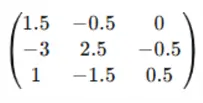
Multiplying both matrices will give us the identity:

Next Steps
Some improvements can be made in the code above when dealing with special matrices, numerical precision due to the floating-point limitations, checking routine for non-singularity, etc.
Also, you can adapt them to your needs:

Sebastião Pereira has over 40 years of experience in database development including T-SQL, algorithm design, machine learning and bringing innovative mathematical formulas to SQL Server. He started his career at a transnational fast-moving consumer goods (FMCG) company as an employee then later transitioning into a consultant role. He eventually founded his own company to develop software solutions for the healthcare industry. Sebastião is a respected award-winning author on MSSQLTips.com extending SQL Server capabilities beyond traditional workloads.
- MSSQLTips Awards
- Author of the Year – 2025
- Trendsetter (25+ tips) – 2025
- Rookie of the Year – 2024