Problem
The Graham scan algorithm is used to find the convex hull of a finite set of points in the plane. In other words, the smallest convex polygon that encloses all points. Is it possible to implement it in SQL Server without the use of external tools?
Solution
The Graham scan algorithm is used to:
- Computer graphics and game development
- Geographic information Systems (GIS)
- Robotics and motion planning
- Image processing and computer vision
- Data analysis and computational geometry
- Telecommunications and sensor networks
Graham Scan Algorithm Logic
The basic idea of the algorithm is:
- Choose a pivot point, the one that has the lowest y-coordinate and the lowest x-coordinate.
- Sort points by its polar angle and the distance from the pivot point.
- Scan and discard concavities, at each step, check the orientation of the last two points on the stack and the new point.
- The result contains the convex hull in counterclockwise order.
Implementing Algorithm in SQL Server
Let’s create a few objects and then do a sample run.
User-defined table type
-- MSSQLTips (TSQL)

CREATE TYPE [dbo].[uttPoints] AS TABLE(
    [n] [int] IDENTITY(1,1) NOT NULL,
    [x] [float] NOT NULL,
    [y] [float] NOT NULL
)
GO
Table-valued function
-- =============================================
-- Author:         SCP - MSSQLTips
-- Create date:    20260113
-- Description:    Graham scan algorithm
-- =============================================
CREATE OR ALTER FUNCTION [dbo].[tvfGrahamScan]
            (@Points dbo.uttPoints READONLY)
RETURNS         @Hull
    TABLE    ([n] int IDENTITY
            ,[x] float
            ,[y] float)
WITH EXECUTE AS CALLER
AS
BEGIN

    DECLARE  @x0 float
            ,@y0 float
            ,@ax float
            ,@ay float
            ,@bx float
            ,@by float
            ,@cx float
            ,@cy float
            ,@n int
            ,@pivot int;

    SELECT TOP 1 @x0 = x
                ,@y0 = y
                ,@pivot = n
        FROM     @Points
        ORDER BY x
                ,y;

    INSERT INTO         @Hull
        VALUES         (@x0,@y0)

    DECLARE cursorTab CURSOR FAST_FORWARD READ_ONLY FOR
        SELECT         x
                    ,y
            FROM     @Points
            WHERE     n <> @pivot
            ORDER BY ATN2(y - @y0, x - @x0)
                    ,SQUARE(x - @x0) + SQUARE(y - @y0);

    OPEN cursorTab
        FETCH NEXT FROM cursorTab INTO @cx,@cy;

        WHILE @@FETCH_STATUS = 0 BEGIN

            SET @n = (SELECT COUNT(*) FROM @Hull);

            IF     @n >= 2 BEGIN
                SELECT TOP 1 @bx = x
                            ,@by = y
                    FROM     @Hull
                    ORDER BY n DESC;

                SELECT         @ax = x
                            ,@ay = y
                    FROM     @Hull
                    ORDER BY n DESC
                    OFFSET 1 ROWS FETCH NEXT 1 ROWS ONLY;

                IF ((@bx - @ax) * (@cy - @ay) - (@by - @ay) * (@cx - @ax)) <= 0
                    DELETE FROM     @Hull
                        WHERE     x = @bx AND
                                    y = @by;
            END

            INSERT INTO     @Hull
                VALUES     (@cx,@cy);

            FETCH NEXT FROM cursorTab INTO @cx,@cy;
        END
    CLOSE cursorTab
    DEALLOCATE cursorTab

    RETURN;
END
GO
Example Graham Scan Algorithm in SQL Server
-- MSSQLTips (TSQL)

DECLARE         @Points AS dbo.uttPoints;

DECLARE         @Hull AS
    TABLE   (n int IDENTITY
            ,x float
            ,y float);

INSERT INTO      @Points
    VALUES       (0, 3)
                ,(1, 1)
                ,(2, 2)
                ,(4, 4)
                ,(0, 0)
                ,(1, 2)
                ,(3, 1)
                ,(3, 3);

INSERT INTO @Hull
    SELECT       x
                ,y
        FROM     [dbo].[tvfGrahamScan] (@Points);

-- Closing the polygon to plot
INSERT INTO         @Hull
    SELECT TOP 1 x
                ,y
        FROM     @Hull;

SELECT * FROM @Hull;

DECLARE      @poly geometry
            ,@w nvarchar(MAX)
            ,@p int = 1;

SELECT     @w = 'POLYGON((' + STRING_AGG(CAST(x AS nvarchar(10)) + ' ' + CAST(y AS nvarchar(10)), ', ') + '))'
    FROM @Hull;

SET @poly = geometry::STGeomFromText(@w, 0);

DECLARE @Ratio float = 0.15;

SELECT         'Polygon' AS Id
    ,NULL AS x
    ,NULL AS y
    ,@poly.STBoundary() AS geom

    UNION ALL

SELECT       CONVERT(nvarchar(10),n)
            ,x
            ,y
            ,([geometry]::Point([x],[y],(0))).STBuffer(@Ratio)
    FROM     @Points;
GO
Resulting in
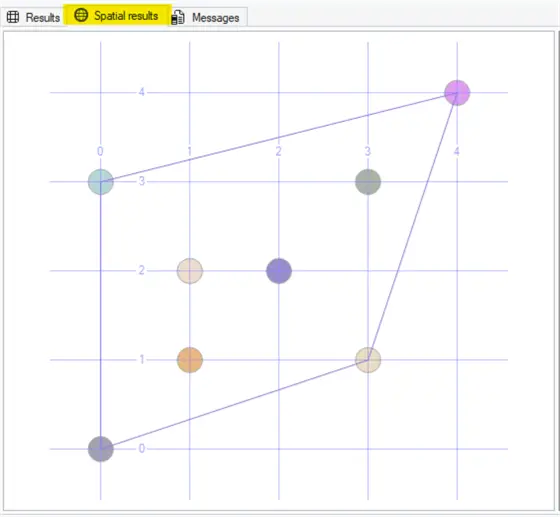
Next Steps
- Instead of the use of Atn2 to sort the values it is also possible to use polar cross-product ordering.
- WIKIPEDIA – Graham scan

Sebastião Pereira has over 40 years of experience in database development including T-SQL, algorithm design, machine learning and bringing innovative mathematical formulas to SQL Server. He started his career at a transnational fast-moving consumer goods (FMCG) company as an employee then later transitioning into a consultant role. He eventually founded his own company to develop software solutions for the healthcare industry. Sebastião is a respected award-winning author on MSSQLTips.com extending SQL Server capabilities beyond traditional workloads.
- MSSQLTips Awards
- Author of the Year – 2025
- Trendsetter (25+ tips) – 2025
- Rookie of the Year – 2024